
Stop losing customers you did not know you were losing.
Atlas reads the sales and purchase records you already keep. It tells you which customers have quietly stopped ordering and what that is worth, records every receipt against the right distributor and expense type, and answers questions about your own numbers in plain English.
Live in 48 hours · one sales export · nothing to install
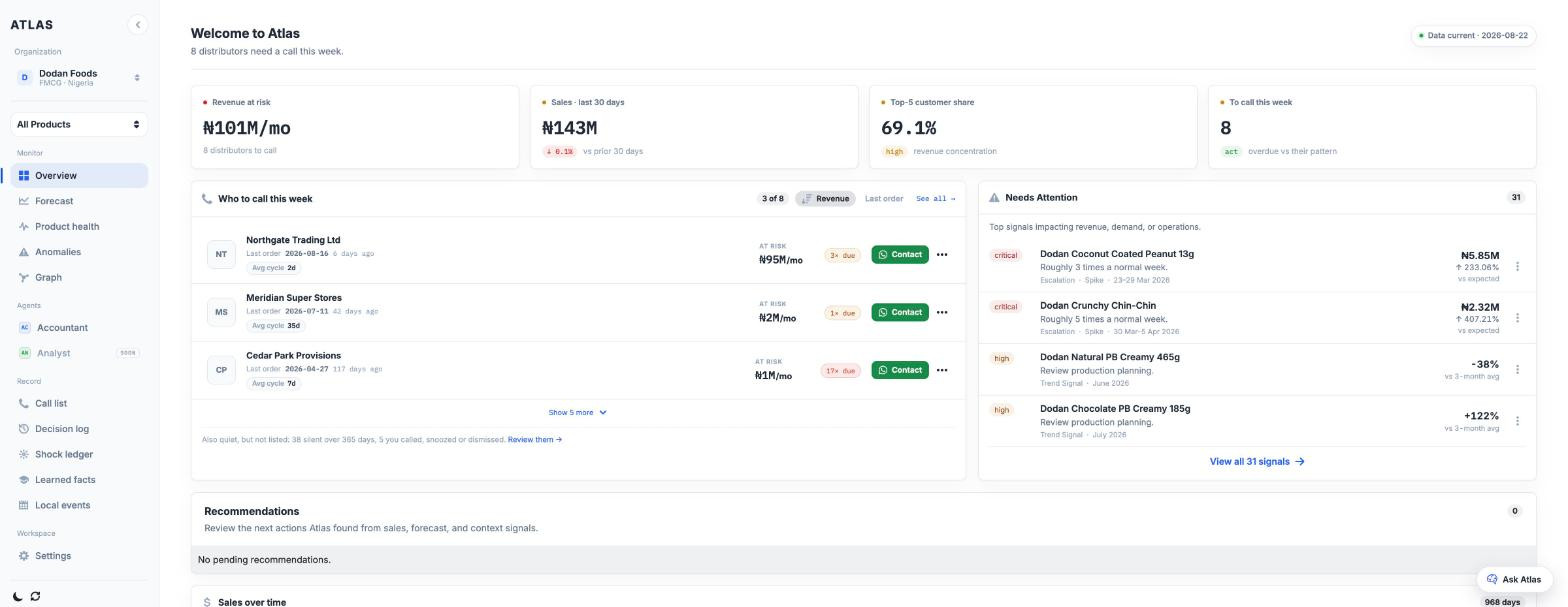
Overdue vs their own pattern
₦4,180,000
31 days silent · usually 14
“Invoices and receipts used to get lost in our inboxes, and we would find out weeks later when our CRM records did not agree during our monthly review. Now the Atlas agent picks up our receipts and invoices from WhatsApp and records it against the right distributor and expense type; I approve it in one click, all without leaving WhatsApp. And when I am planning production I ask it a question in plain English instead of waiting for somebody to build me a report. The time savings have been a game-changer.”
Dr. Tersee Gemana
Managing Director · Dodan Foods Nigeria

FMCG manufacturing and distribution, Nigeria.
₦100M+
Nigerian naira
of revenue found sitting in accounts that had gone quiet
92%
of receipts need no correction
recorded against the right distributor and expense type without anyone retyping them
48 hours
from one export to your first call list
named customers, ranked by what they are worth, ready to phone
Naira is the currency of record. Dollar and euro shown at ₦1,391.61 / $1 and ₦1,624.91 / €1 — mid-market, 23 August 2026.
Nobody sends a cancellation. They just stop ordering.
Every account buys on its own rhythm — every fortnight, every month, every quarter. That rhythm is already sitting in your records, and the moment a steady customer breaks it is the earliest warning you will ever get. It is also the one nobody is watching for.
What it costs you today
Across hundreds of customers, the ones slowing down disappear into the averages. By the time a monthly report shows a hole, the relationship has cooled and somebody else has called them.
What changes
Atlas holds a separate baseline for every account and checks all of them every morning. You get a name, a number and a reason — while the customer is still winnable.
RECEIPT · IMG_2481.JPG
Illustrative thread · the flow is real
What changes in your week.
All of it runs on records you already keep. Nothing new to write down, no system to migrate, no habit to adopt.
You find out in days, not quarters
Every account is checked against its own reorder rhythm each morning. When a steady customer goes past their normal gap, you hear about it while they are still winnable.
Your reps know who to phone first
The list is ranked by naira at risk, so the ₦4m account gets called before the ₦40,000 one — with the reason it slipped and a message already drafted.
No more invoices going missing
Staff send a receipt over WhatsApp and Atlas records it against the right distributor, the right amount and the right expense type — and they approve it without leaving the chat. Duplicates are caught before anything is posted.
Month-end stops being a scramble
Because entries are recorded as receipts arrive rather than in a rush at the end, the books already agree when you go to close them.
Answers without waiting for a report
Ask what to plan production around, or which region slowed last quarter, in plain English. The answer comes off your own transaction history.
You see demand coming, not going
Which accounts are due to reorder, and the holidays, promotions and price shocks about to move demand — early enough to buy for it.
A call list, not a dashboard to check.
Every quiet account with its last order, its own average cycle, and how many cycles it has now missed — sorted so the biggest number gets the first call. It arrives in Slack or WhatsApp, so nobody has to remember to log in.
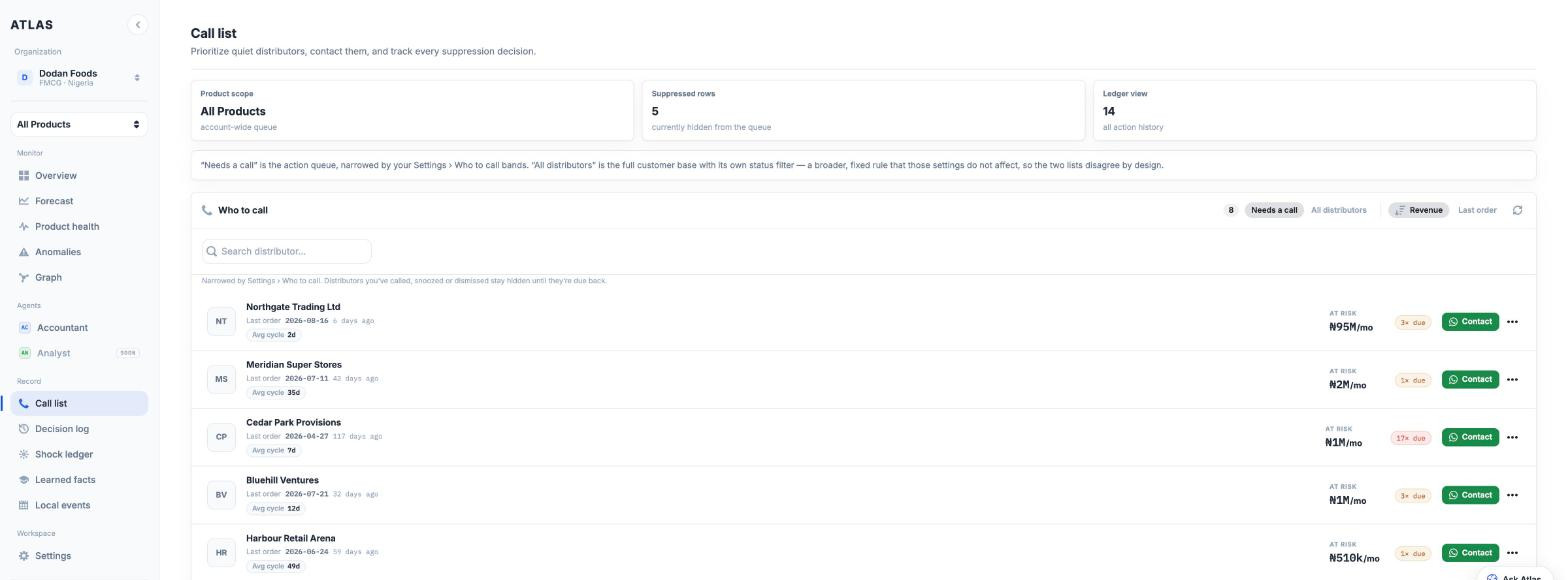
Live console · customer names anonymised
The invoice nobody remembered to file.
Data entry is where money quietly goes wrong. A receipt lost in somebody’s inbox, an amount keyed twice, a bill that never made it into the system at all — and you find out weeks later, at the monthly review, when the records do not agree.
The receipt arrives over WhatsApp
No portal, no inbox for it to get lost in. Staff send it the way they already message, and Atlas picks it up.
Atlas reads it and prepares the entry
It pulls out the distributor, the amount, the date and the bank reference, decides the expense type, checks it against what you have already recorded, and flags a duplicate before it becomes one.
You approve it in one click
Nothing is posted until you say so — and you approve it from inside WhatsApp, not from a portal. Every decision is logged, and anything can be reversed.
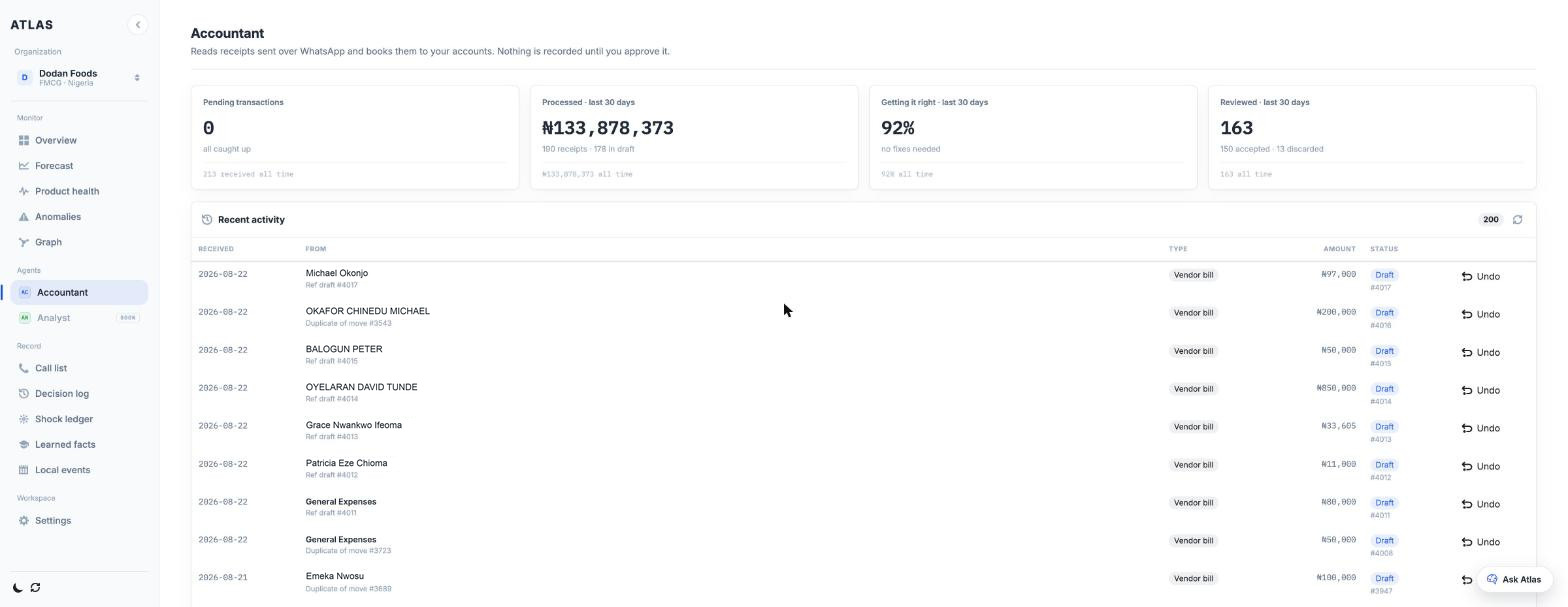
Live console · distributor names anonymised
Get the answer today, not next Tuesday.
How much to make next month. Which region went soft. What a customer was buying before they stopped. Ask in plain English and the answer comes back off your own books — no dashboard to build, nobody to wait for.
Production planning without the guesswork. Ask what last quarter actually did, by product, before you commit a run.
Your numbers, not an estimate. Every answer comes off your own transaction history, and shows what it counted.
Anyone on the team can ask. If you can type the question, you can have the answer. No training, no query language.
Asked in the console
How much chin-chin should we plan for next month, and which accounts drove the last three months?
Atlas answers from your own sales history — volume by product, the accounts behind it, and the pattern it expects next month.
Illustrative exchange. The answer shape is real; the wording depends on your data.
From a spreadsheet to a phone call in three moves.
No stock counts, no migration, no new habit. Atlas reads what you already record.
Step one
Send your sales records
Your CRM, ERP or accounting system — or a CSV export from a spreadsheet. However your sales data lives, Atlas takes it in.
Step two
Atlas learns each rhythm
It maps every account’s own reorder cadence and basket size, then watches all of them for the ones that break it.
Step three
Your team makes the calls
Who went quiet, how long, what it is worth — ranked, in Slack or WhatsApp. One tap to act on it.
Your sales ledger is the most sensitive thing you own.
You are handing over who buys from you, how often, and for how much. Here is exactly what happens to it.
Read-only on your sales data
Atlas reads your sales records. It does not write to your ERP, move stock, or change a price.
Nothing enters your accounts without you
Atlas prepares the entry; you approve it. Nothing is recorded until a person clicks approve, every decision is logged, and anything can be reversed.
Isolated to your organisation
Your data sits behind your own login, scoped to your organisation. No shared pool, no cross-customer views.
Never used for training
Your data is never used to train models. It answers your questions about your accounts, and nothing else.
Deleted on request
Ask, and your export and everything derived from it is removed. There is a page for it, not a support queue.
One export, not an integration
A pilot needs a single sales export. No credentials, no agent on your network, nothing installed.
The questions you would ask on the second call.
Answered here so you do not have to sit through a demo to find out.
You can, and it will tell you what already happened. A report shows totals against a period; it cannot tell you that a customer who has ordered every fourteen days for a year is now on day nineteen. Atlas measures each account against its own history, not a company average — which is why a slip shows up in days rather than at quarter close.
A general model has never seen your order book. Atlas is built on your actual transaction history, with a per-account cadence model underneath and your product and customer names mapped in. The language model writes the message; the maths that decides who to call is not a language model at all.
Messy is normal — inconsistent product names, duplicate customers, missing regions. Mapping your columns to something Atlas can reason about is part of onboarding, done once, with you reviewing the result. You do not need to clean anything before you start.
Only once you approve it. Atlas prepares the entry — distributor, amount, date, bank reference and the expense type it belongs to — checks it against what you have already recorded, flags duplicates, then waits. Nothing is recorded until a person clicks approve.
It is deleted. Your export and everything derived from it — models, alerts, history — is removed on request, and there is a page to ask for it. Nothing is retained as leverage to get you back.
A flat monthly subscription — not per seat, and not a share of what you recover. We will walk you through the number on the demo, once we know how many customers you serve and which parts you want switched on.
Find out what is quietly leaving.
Send one sales export and we will show you exactly which of your accounts have gone quiet and what they are worth — on a live console, within 48 hours.
A 30-day pilot. You see the revenue at risk in your own book before you commit to anything.
Your data stays yours. One export, isolated to your organisation, never used for training, deleted on request.
Named accounts on the first call, not a sales deck. You will recognise every company on the list.
Got it, there.
We will be in touch within one business day to set up your 48-hour preview.
Book your demo call
Atlas reads the sales and purchase records you already keep, tells you which customers have stopped ordering, and files every receipt against the right account.
What Atlas does
Company
Get started
© 2026 Atlas · ZeroOne
Built in Nigeria, for repeat-order businesses