
One system. Three things it stops costing you.
Atlas reads the sales and purchase records you already keep. It catches customers who have quietly stopped ordering, records every receipt against the right account without anyone retyping it, and answers questions about your own numbers in plain English.
You find out in days, not at quarter close.
A customer who has ordered every fourteen days for a year, now on day nineteen, is a problem you can still fix. The same customer three months later is a problem you have lost. Atlas holds a separate baseline for every account and checks all of them every morning.
Ranked by what is at stake
Every quiet account with its last order, its own average cycle, and how many cycles it has missed — biggest number first.
With the reason and the message
Why they slipped, what to offer, and a draft you can send as it is — so the call takes two minutes, not twenty.
Delivered where your team already is
Slack or WhatsApp, every week. Nobody has to remember to open a dashboard.
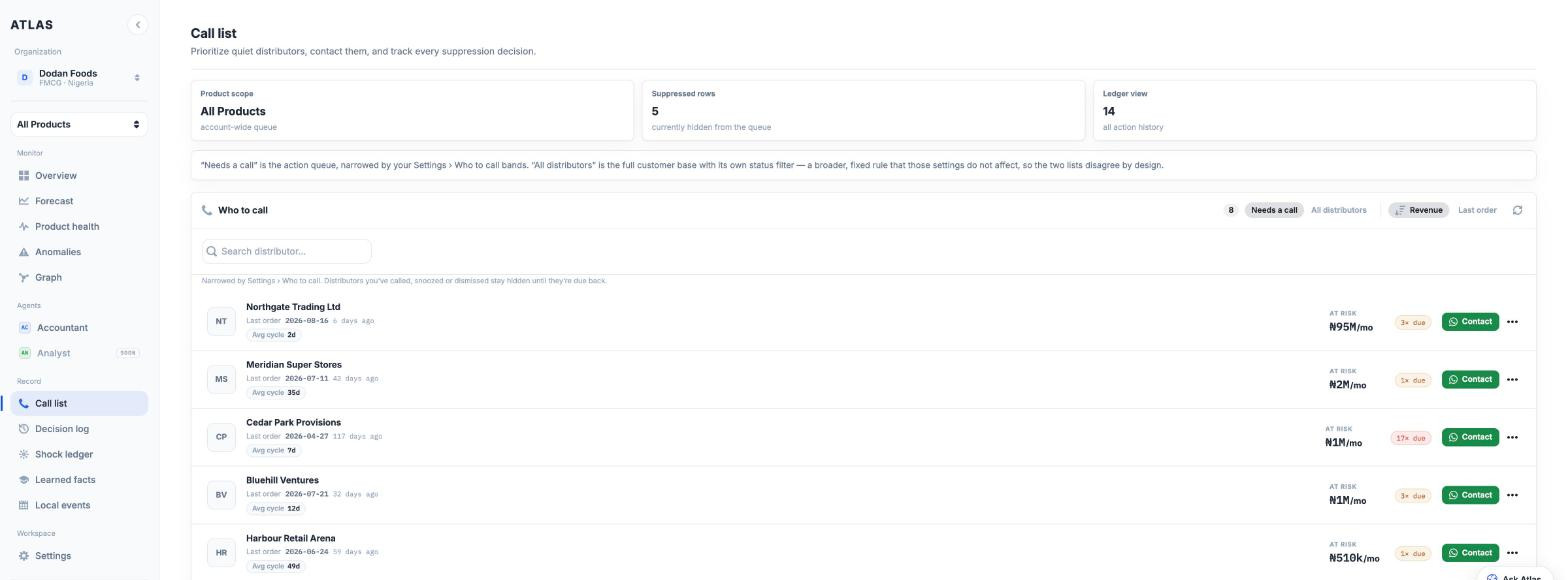
Live console · customer names anonymised
Nothing goes missing between the receipt and the ledger.
Data entry is where money quietly goes wrong — a receipt somebody forgot to upload, an amount keyed twice, a supplier bill that never made it in. Atlas closes the gap between someone holding a receipt and it being recorded correctly.
It arrives over WhatsApp
No portal, no upload anyone has to remember. Staff send it the way they already message each other.
Read, matched, checked
Supplier, amount, date and bank reference pulled out; the right account chosen; checked against what you have already recorded so a duplicate is caught before it is booked.
Approved in one click
Nothing enters your accounts until you say so. Every decision is logged and anything can be reversed.
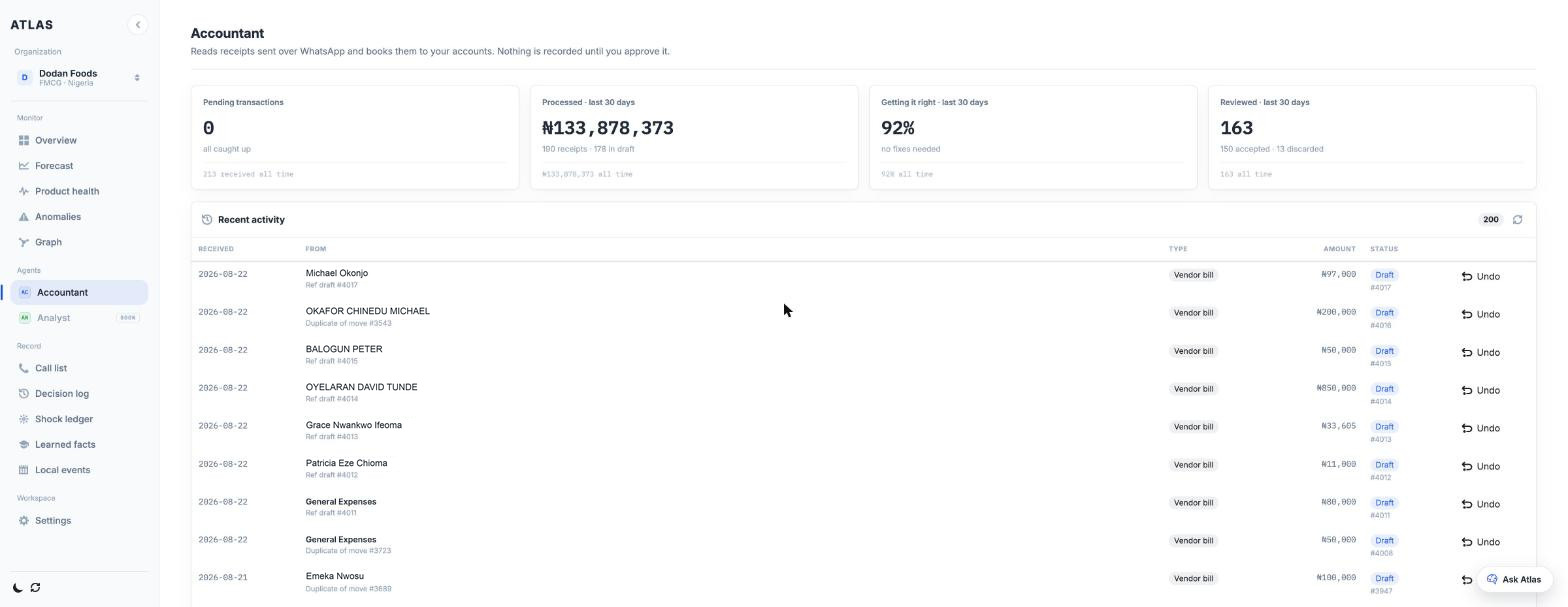
Live console · supplier names anonymised
Get the answer today, not next Tuesday.
How much to make next month. Which region went soft. What a customer bought before they stopped. Ask in plain English and the answer comes off your own books.
Production planning without the guesswork. See what last quarter actually did, by product, before you commit a run.
Your numbers, not an estimate. Every answer comes off your own transaction history, and shows what it counted.
Anyone on the team can ask. No training, no query language, no report queue.
Asked in the console
Which northern accounts slowed down last quarter, and what were they buying before they did?
Atlas answers from your own sales history, and shows you what it counted.
Illustrative exchange. The answer shape is real; the wording depends on your data.
However your records live, Atlas reads them.
A pilot needs one sales export. A standing connection is a choice you make afterwards, once you have seen it work.
Odoo
A live connection to invoices and bills, with anything that touches money gated behind your approval.
QuickBooks and CRM systems
Read on a schedule, mapped once, leaving your system of record exactly where it is.
CSV or Excel export
The fastest way to start. One export, and you have a call list inside 48 hours.
What comes after retention.
What you get today stands on its own. The rest is the direction of travel.
Winning back the ones already gone
Lapsed high-value accounts that crossed the line months ago, worth a deliberate push rather than a phone call.
Cash out of slow stock
See what is tied up in stock that is not moving — hold these, reorder those — without adopting a stock-count habit.
Funding the reorder
When a customer is ready to buy but cash is tight, pay now or pay as the stock sells.
See it on your own numbers.
Send one sales export and we will show you which of your accounts have gone quiet and what they are worth, within 48 hours.
48-hour setup · 30-day pilot · nothing to install
Atlas reads the sales and purchase records you already keep, tells you which customers have stopped ordering, and files every receipt against the right account.
What Atlas does
Company
Get started
© 2026 Atlas · ZeroOne
Built in Nigeria, for repeat-order businesses